Back to Top

An Apology and a Promise

Wow, here it is the beginning of December –is anyone else wondering where November went? Sometimes, as the days fly by, I wonder if time seemed to go by this fast to people who lived during the Regency –or pick any given historical time period. With all our modern time-saving conveniences, how is it that we seem to live at a frenetic pace? (I know this isn’t only me!!) Is it because we try to cram more activity into our days, simply because we can? Has time actually sped up (a theory I read somewhere…)?? What do you think?

The reason I am ruminating on all of this today is because, even though I knew today was my day to blog here, I never did have time this week to choose a topic or prepare a post. So that’s the apology –I’m sorry I don’t have an actual post for today!! I did consider asking among my sister Riskies if anyone wanted to swap dates, but I never even got a chance to send out that appeal. This is the first time I’ve ever just completely missed posting here.

The promise is that in January I should have some real news to share! I’m looking forward to that. In the meantime, I want to wish all of you the most wonderful holidays –whatever you celebrate. It’s the season of light and love, that we should try to hold in our hearts and share with each other all year long. I think our world needs it more than ever!!!

In place of my post, here are two pictures of what has eaten up my extra time this week –things I’ve made for my church bazaar which is tomorrow. I am the coordinator for vendors and have been fielding phone calls and emails from them all week, while measuring and re-measuring the church hall and tweaking the floor lay-out to make sure there’s room for everyone besides all the tables full of church-made items.  We set up today, so we’ll see! In the meantime, sending you love and best wishes. And an early “Happy New Year”!!


img_6100img_6102

Save

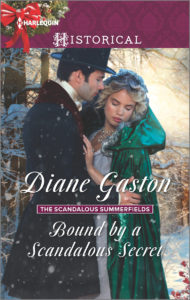
Bound By A Scandalous Secret

Bound by a Scandalous SecretBound By A Scandalous Secret, my latest book and the third book in the Scandalous Summerfields, is released today!

Here’s the back cover blurb:

A most shocking betrothal!
The pleasure-seeking Marquess of Rossdale has little interest in his birthright and even less in finding a bride. So he comes up with the perfect plan to survive the Season unscathed—a fake engagement to a most unsuitable girl!
Outspoken Genna, the youngest of the scandalous Summerfields, has no wish to marry, either. So agreeing to be Ross’s temporary fiancée will grant her freedom for a little longer. But with every kiss, both Ross and Genna must face up to what they really desire… a true match!
The Scandalous Summerfields–Disgrace is their middle name.

Genna’s story begins in the Christmas season of 1815 and ends at Christmas 1816. The gifts Genna and Ross share on that first Christmas are meaningful, but not valuable.

When I strive to give gifts, I always hope to make them meaningful, but I’m rarely successful, so I was pleased I could make Genna and Ross’s gifts so.

You know, books make great Christmas gifts. Feel free to give a friend or relative Bound By A Scandalous Secret.  Or treat yourself!

In many ways, this book is about giving and expecting nothing in return. That’s pretty much the essence of love, isn’t it?

You can purchase the paperback of Bound By A Scandalous Secret at bookstores and online vendors. Book Depository has the book on discount!

(Prefer the ebook? The ebook will be released December 1)

St. Brice’s Day

I love finding local events to include in books. They can be fun inciting events, or random bits of action, or just a bit of historical authenticity. It’s the little things like this that add verisimilitude and depth to a book (at least in my opinion). One of my go-to sources for this kind of thing is The English Year by Steve Roud. It’s an absolutely fabulous book that goes through the whole year listing events and celebrations all over England. I’ve used something out of it for every book.

3868

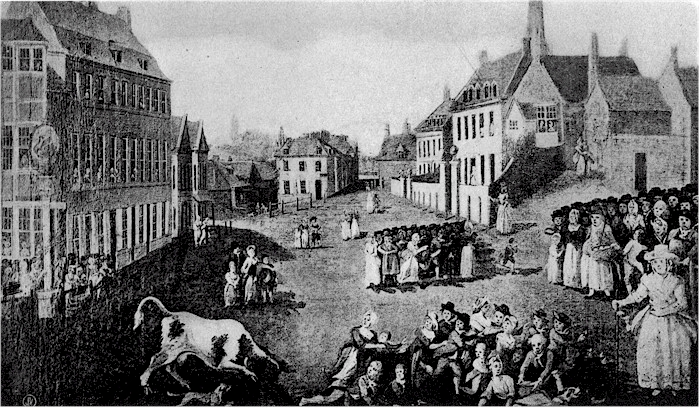
The Stamford Bull-Run, 18thC

So, if we were dropped into Georgian England this week, what might happen? Well, if it happened in the city of Samford, we might get trampled by bulls. On Nov 13th (or the 14th if the 13th fell on a Sunday as it did this year), the Stamford Bull-Running took place up until the 1839 when it fell afoul of reformers.

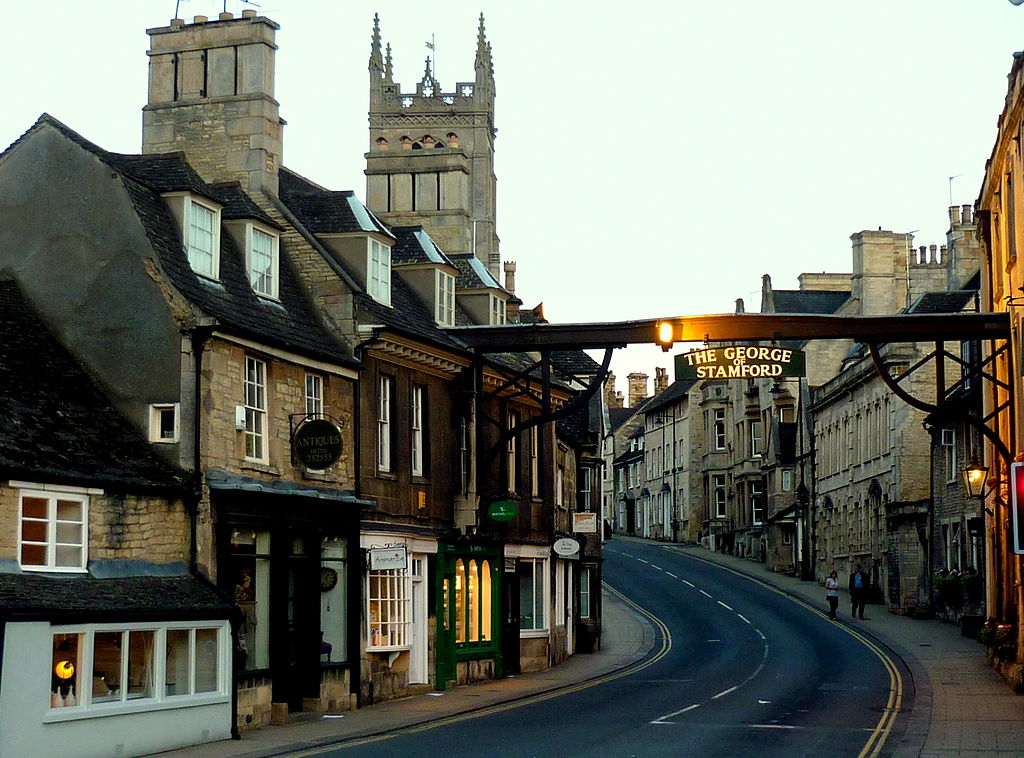
1024px-high_street_st_martins_stamford

Stamford (photo by SmileyRose – Wikimedia Commons)

According to local tradition, the custom was started in the 12th century by William de Warenne, 5th Earl of Surrey, after he saw two bulls fighting in the meadow. When the butchers tried to part them, the bulls ran into the town. The earl so enjoyed the resulting ruckus (and giving chase) that he decreed it would be an annual event.

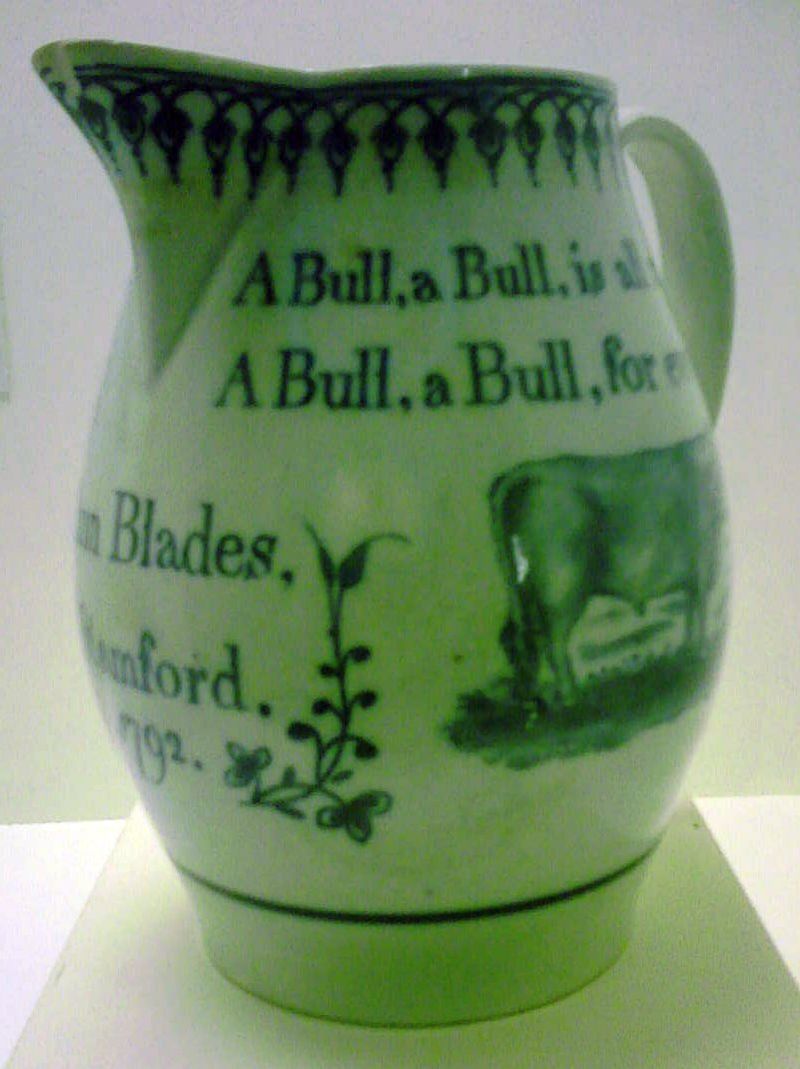
800px-stamfordmuseum_bull_run_memorial_jug

A jug commemorates Ann Blades – a Stamford bull runner in 1792 (photo by Roger from Derby, UK Wikimedia Commons)

The city would block off side streets and board up windows. At 10:35AM the church bells would ring, alerting people to clear the street, and then the bull would be released and the crowd of “bullards” and their dogs would chase it through the main thoroughfare. When they reached the bridge, the bull would be tossed over into the water, and then pursued into the field, slaughtered, roasted and eaten (later the meat was sold off cheaply, rather than cooked and consumed on the meadow).

 
By the late 18th century, bloodsports (and anything that involved riotous celebration by the poor and working class) were falling out of favor. The local paper in 1785 commented:

 
Monday last being our annual bull-running, the same was observed here with the usual celebrity—several men heated with liquor got tossed by the bull, and were most terribly hurt, while some others more sober had little better usage. What a pity it is so barbarous a custom is permitted to be continued, that has no one good purpose to recommend it, but is kept as an orgy of drunkenness and idleness to the manifest injury of many poor families, even tho’ the men escape bodily hurt.”

The bull-run became a major cause for reformers, and was first banned in 1788, but the powers that be were unable to suppress the custom and eventually gave up trying. The cause was again taken up in 1824 by the newly formed Society of the Prevention of Cruelty to Animals, and ending it (by turning the tide of local opinion) was their first major success. [ok, so this was an entirely unexpected discovery when I chose this topic, it’s a twofer for anyone wanting to write an authentic reformer hero or heroine!).

So, happy St. Brice’s day! Be glad you weren’t trampled by a bull.

Author Websites

I’m putting some serious thought into a long-needed upgrade to my rather lamentably home-made website, www.elenagreene.com and I’d love to have some input from readers.

Of course it is important to have a website that is uncluttered and easy to navigate. Although I personally don’t care to surf the web on my phone, but I know a lot of people do, so it’s also looking important to have a site that is mobile-friendly.

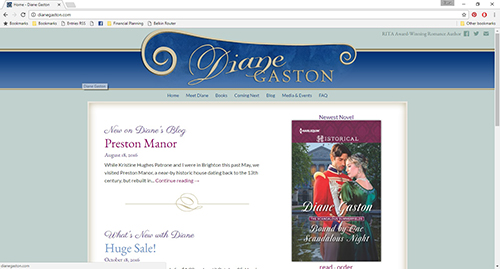
As for style, I’ve been looking through a lot of historical romance authors’ websites to get ideas of what might work for mine. One of my favorites is our own Risky Diane’s website at www.dianegaston.com. Here’s a screenshot. I think it’s elegant and has a romantic, historical feel without being too busy or flowery.

dianegastonwebsite

Some other website along these lines include: www.lorettachase.com and www.janmarieanello.com.

I also do happen to enjoy sites that have more imagery, including romantic couples and stately homes. Some examples: www.sarahmaclean.net and www.cynthiawrightauthor.com.

I’ve also noticed that some sites combine simple, elegant graphics with an author portrait. Examples: www.eloisajames.com and www.tessadare.com. I’d probably want to get a new headshot for this type of site, although that might be a good idea anyway.

So I’d love to hear what you think.

[poll id=”29″]
[poll id=”30″]
[poll id=”31″]
[poll id=”32″]

Please feel free to comment on any of your answers and let me know if there’s anything else you think is important.
Thanks!
Elena

Elections, Regency Style Redux!

I originally wrote this blog Nov 5, 2012, so this is a redux (giving me time to finish the work-in-progress)

Tomorrow is Election Day here in the USA and when you live in a swing state (Virginia) in the suburbs of the nation’s capital (Washington, D.C.), You. Cannot. Escape. This. Fact. Ever. (Diane Note: I would daresay, if you are a citizen of the WORLD this election cycle, You. Cannot. Escape. This. Fact. Ever.)

If I lived in Regency England, though, things would be a lot different. An election would only be for members of the House of Commons. In the early 1800s, the House of Lords consisted of hereditary peers and, of course, the king was not elected. Members of Parliament served until Parliament was dissolved, every five years unless emergency extensions were necessary.

Fairness was a rare commodity in election to the House of Commons. Some “pocket boroughs” were in the pocket of the local magnate or his designee and, therefore, had no real opposition. Other “rotten boroughs” might have small enough numbers of voters that all could be successfully bribed, while areas as densely populated as Manchester had no representative. For example, Old Sarum in Wiltshire had three houses and seven voters. The Reform Act of 1832 dissolved the rotten boroughs and more evenly distributed representation.

Like in the US, there were two main political parties. Generally speaking, the Tories were conservative, wanting to maintain the status quo, while the Whigs advocated electoral, parliamentary, and social reform. After the French Revolution, the Tory party experienced years of largely uncontested power. Before he became Prince Regent, George IV supported Whig sentiments, but when in power, he turned Tory.

The only people who could vote in Regency England were male landowners. Only one man in seven could vote in England; one in 44 in Scotland. Women did not earn full voting rights in the UK until 1928.

So when I cast my vote tomorrow, I’ll be grateful that I have a voice in my government and I’ll appreciate how different it would have been if I had lived in my beloved Regency England.

Go vote!!